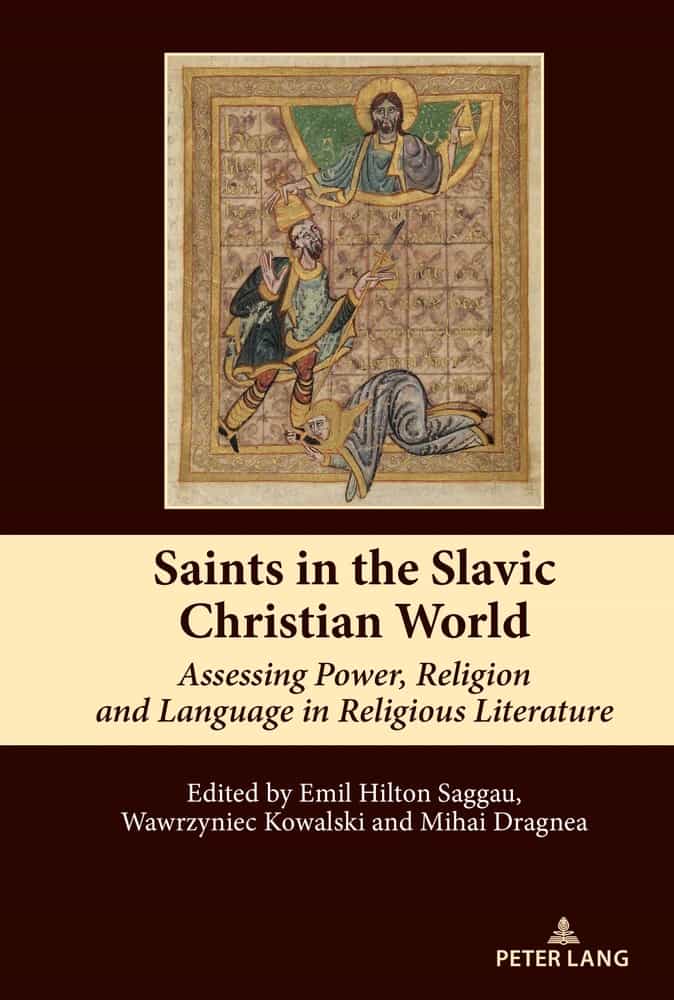
The volume “Saints in the Slavic Christian World: Assessing Power, Religion and Language in Religious Literature“, edited by Emil Hilton Saggau, Wawrzyniec Kowalski and Mihai Dragnea and published by Peter Lang (Open Access) in the series South-East European History, shows how saints became symbols of power during conversion and the process of transition to Christianity. It argues that saints are an outward expression of Christianity becoming embedded and localized in the newly Christianized societies of East and Central Europe. The volume is the product of two online seminars on “The Saints in the Slavic Christian world (900–1400) – Assessing Culture, Power, Religion and Language in Slavic Hagiographies and Religious Literature,” jointly hosted by Lund University, Ghent University and the Balkan History Association in January 2022. Editors are members of the association.
Table of Contents
List of Figures and Tables
Introduction: Assessing Slavic Saints, Emil Hilton Saggau, Wawrzyniec Kowalski and Mihai Dragnea
The Legacy of the Iconophile Theology of Vita Constantini, Ljubica Jovanović
The Conversion of Pagan Rulers of Lithuania, Yanina Ryier
Prince Voyshelk as a Local Saint, Vytas Jankauskas
St. Parascheva of Epibatae the Younger, Evelina Mineva
Saint Adalbert and the Five Brother Martyrs, Maria Starnawska
When Sainthood Is Not Enough—Biblical Legitimization of Dynastic Power in Kyivan Rus’, Susana Torres Prieto
The Life of Saint Theodosius of the Cave and the Genre Tradition, Dariya Syroyid
Transmission Practices in the Early Hagiography of Rus’ Before the 16th Century, Karine Åkerman Sarkisian
The Latin Mass in Old Church Slavonic, Silvio Košćak & Kristijan Kuhar
The Waldensian Concept of Catholic Saints: Total Rejection or Hidden Faith, Aliaksandra Valodzina
The Holy Kings and the Forms of Sanctity in The Chronicle of the Priest of Duklja, Wawrzyniec Kowalski
Killing the Tsar, Again—Power and Sainthood Among the Early Slavic Ruler Saints, Emil Hilton Saggau
Notes on Contributors